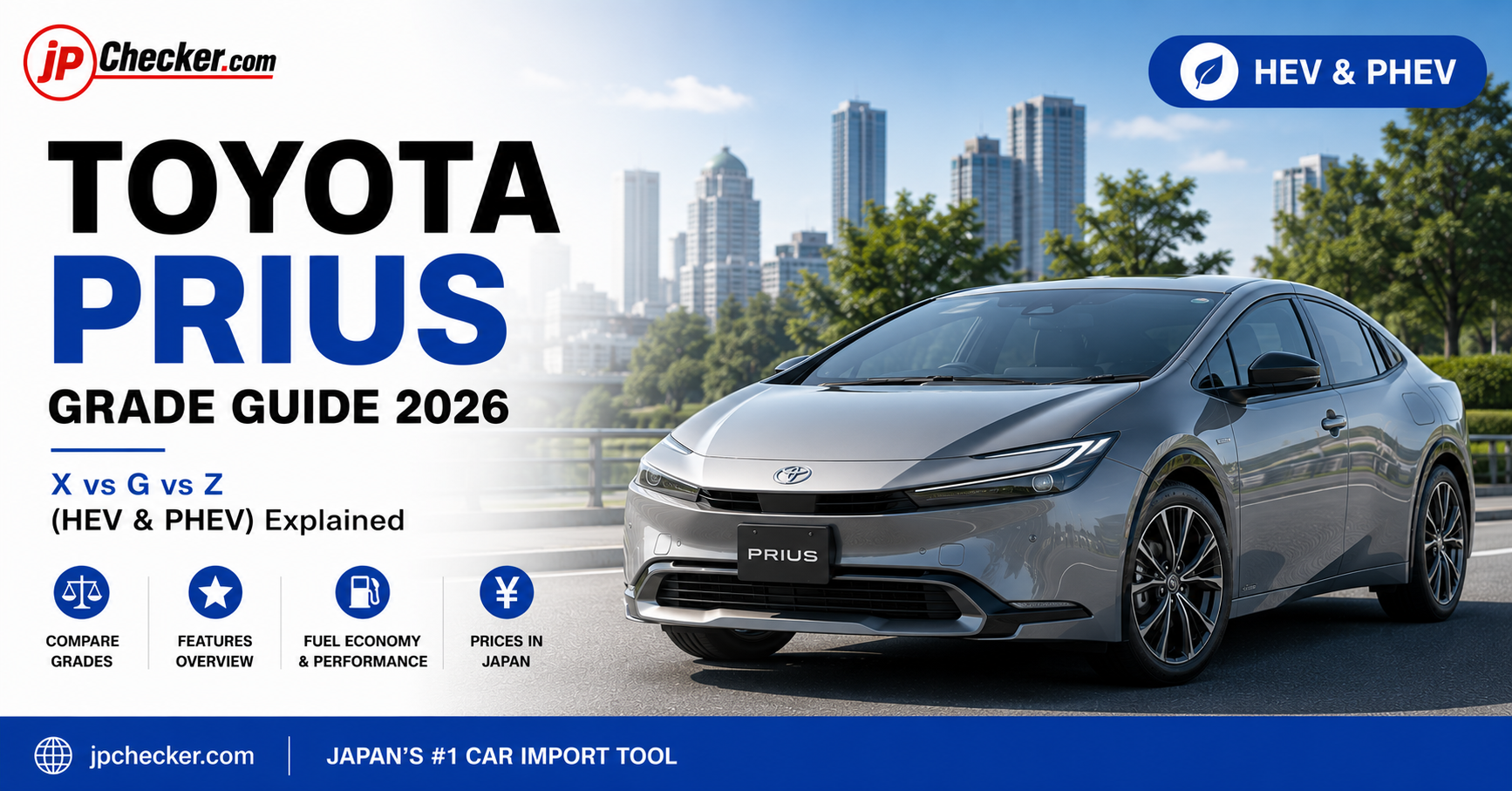
Toyota Prius Grade Guide: X vs G vs Z (HEV & PHEV) — All Differences Explained
The car that invented the mass-produced hybrid, decoded grade by grade. Two powertrain families, five regular grades, and a subscription-only special grade — here's exactly what separates X, G, and Z in both hybrid and plug-in hybrid form, plus what changed in the most recent July 2026 update.
📅 Current Model: Fifth-generation Prius (HEV since January 2023, PHEV since March 2023, last updated July 1, 2026) 🚗 Grades: X · G · Z (HEV) · G · Z (PHEV) · U (KINTO Unlimited subscription-only) 🇯🇵 Japan Domestic Market 🏆 World's First Mass-Production Hybrid Passenger Car (1997)
What Is the Toyota Prius?
The Prius debuted in December 1997 as the world's first mass-produced hybrid passenger car, and has spent nearly three decades since as Toyota's flagship demonstration of hybrid technology. The current fifth generation switched to a noticeably lower, sportier "hammerhead" design language shared across recent Toyota electrified models, moving away from the more upright, purely function-first shape of earlier generations. The hybrid (HEV) version launched in January 2023, with the plug-in hybrid (PHEV) version — renamed from the previous generation's "PHV" branding to the globally standard "PHEV" — following in March 2023.
Unlike some Toyota model lines that keep a single powertrain across the range, the Prius splits its grades across two distinct hybrid systems and, separately, a plug-in hybrid system with genuine EV-only range — meaning grade choice and powertrain choice are tied together in ways that aren't always obvious from the grade name alone.
Grade Lineup at a Glance
| Grade | Powertrain | Drive | Price (JPY, tax incl., as of July 1, 2026) | WLTC Fuel Economy / EV Range |
|---|---|---|---|---|
| HEV X | 1.8L Hybrid | FF / E-Four | ¥2,796,200 (FF) / ¥3,049,200 (E-Four) | 32.6 km/L (2WD) |
| HEV G | 2.0L Hybrid | FF / E-Four | ¥3,324,200 (FF) / ¥3,577,200 (E-Four) | Lower than X (larger engine, sportier tune) |
| HEV Z | 2.0L Hybrid | FF / E-Four | ¥3,998,500 (FF) / ¥4,251,500 (E-Four) | Lower than X (larger engine, sportier tune) |
| PHEV G | 2.0L PHEV | FF only | ¥3,884,100 | 87 km EV range (WLTC) |
| PHEV Z | 2.0L PHEV | FF only | ¥4,645,300 | 87 km EV range (WLTC) |
| U (KINTO Unlimited only) | 1.8L Hybrid | FF only | Subscription pricing via KINTO | 32.6 km/L (2WD) |
Prices per Toyota's official Japan-market pricing following the July 1, 2026 running update — the most recent price increase across the range at the time of writing. Hokkaido-region pricing runs higher across all grades due to cold-weather specification. The U grade is not purchasable outright; it's only available through Toyota's KINTO Unlimited subscription service.
Three Powertrains Under One Name
Unlike the Corolla, which consolidated onto a single hybrid system, the Prius deliberately splits its lineup across three distinct powertrains depending on grade.
1.8L Hybrid (HEV X, U grade)
- The efficiency-focused powertrain, reserved for the entry HEV X grade and the subscription-only U grade
- Delivers the best fuel economy in the range at 32.6 km/L WLTC (2WD)
- Available in FF or E-Four (4WD)
2.0L Hybrid (HEV G, HEV Z)
- A larger, more performance-oriented hybrid system than the 1.8L unit
- Trades some fuel economy for stronger acceleration and a sportier driving character
- Available in FF or E-Four (4WD)
- As of the July 2026 update, the top HEV Z grade gained an Adaptive High-beam System (AHS), previously exclusive to the PHEV Z grade
2.0L PHEV (PHEV G, PHEV Z)
- Toyota's plug-in hybrid system, offering roughly 87 km of WLTC-rated EV-only range from a home or public charge
- Capable of EV-mode driving up to 135 km/h, meaning the car can stay in electric mode even at highway speeds as long as battery charge remains
- FF only — no 4WD option on either PHEV grade
- Supports both external power supply (running appliances from the car) and vehicle-to-vehicle charging ("kuruma de kyuden")
- Eligible for Japan's CEV subsidy program, unlike the standard HEV grades
If fuel economy and price are the priority, HEV X is the obvious pick. If you want the sportiest standard driving feel, HEV Z. If you can charge regularly and want to run most daily trips on electricity alone, PHEV G or PHEV Z are the only grades that offer that.
Full Grade Breakdown
HEV X — Entry Grade
From ¥2,796,200 (FF)
- 1.8L hybrid powertrain, the most fuel-efficient in the range
- Full Toyota Safety Sense suite standard
- As of the July 2026 update, speed-sensing auto power door lock with impact-sensing unlock added as standard across every grade, including X
HEV G — Mid Grade
From ¥3,324,200 (FF)
- 2.0L hybrid powertrain instead of X's 1.8L unit
- 19-inch aluminum wheels (195/50R19 tires), hybrid-specific design in dark gray metallic with a center ornament
- 8-inch Connected Navi-compatible display audio
- 6-way manual sport seat (driver's side)
- Gloss black trim on lower grille, rear bumper lower, and wheel arch moldings is replaced with plain black on G, versus Z's glossier finish
HEV Z — Top Grade
From ¥3,998,500 (FF)
- Same 19-inch wheel size as G, but with a glossier dark gray metallic finish and center ornament
- 12.3-inch Connected Navi-compatible display audio (versus G's 8-inch unit)
- 8-way power sport seat (driver's side), replacing G's manual 6-way seat
- Anti-glare inner mirror
- Gloss black exterior trim on lower grille, rear bumper, center pillar garnish, and wheel arch moldings
- As of the July 2026 update, gains the Adaptive High-beam System (AHS) previously reserved for PHEV Z
- LED accessory lamps and additional high-gloss black exterior detailing versus G
PHEV G — Entry Plug-In Grade
From ¥3,884,100 (FF only)
- 2.0L PHEV powertrain, 87 km WLTC EV-only range
- Same-size 19-inch PHEV-specific aluminum wheels (195/50R19), finished in polished + black with a center ornament, distinct from the HEV wheel finish
- 8-inch Connected Navi-compatible display audio
- 6-way manual sport seat (driver's side)
- Black (non-gloss) exterior trim on lower grille, rear bumper, and wheel arch moldings, versus PHEV Z's gloss black
PHEV Z — Top Plug-In Grade
From ¥4,645,300 (FF only)
- Same 2.0L PHEV powertrain and EV range as PHEV G
- Sportier-finish 19-inch PHEV-specific wheels, polished + black with center ornament
- 12.3-inch Connected Navi-compatible display audio
- 8-way power sport seat (driver's side)
- Red-stitched steering wheel and red shift knob accents, distinguishing PHEV Z's interior even from the equivalent HEV Z
- Adaptive High-beam System (AHS), standard since before the HEV Z grade gained it in July 2026
- Gloss black exterior trim throughout
U — KINTO Unlimited Subscription Grade
Subscription pricing only, not available for outright purchase
- 1.8L hybrid powertrain, matching HEV X's fuel economy
- Available exclusively through Toyota's KINTO Unlimited subscription plan, which bundles the vehicle with a "shinka" (upgrade) and "mimamori" (watch-over/connected monitoring) package
- Positioned by Toyota as a way to access upgraded safety and connected features without an outright purchase
Full Feature Comparison Table
| Feature | HEV X | HEV G | HEV Z | PHEV G | PHEV Z |
|---|---|---|---|---|---|
| POWERTRAIN | |||||
| Engine displacement | 1.8L | 2.0L | 2.0L | 2.0L PHEV | 2.0L PHEV |
| 4WD (E-Four) available | ✓ | ✓ | ✓ | ✗ | ✗ |
| Adaptive High-beam System | ✗ | ✗ | ✓ (added July 2026) | ✗ | ✓ |
| EXTERIOR | |||||
| Wheels | Standard | 19-in alloy, dark gray metallic | 19-in alloy, gloss dark gray metallic | 19-in alloy, polished + black | 19-in alloy, polished + black (sport finish) |
| Gloss black exterior trim | ✗ | Partial (matte black) | ✓ (full gloss) | Partial (matte black) | ✓ (full gloss) |
| LED accessory lamps | ✗ | ✗ | ✓ | ✗ | ✓ |
| INTERIOR | |||||
| Display audio | Standard | 8-in Connected Navi | 12.3-in Connected Navi | 8-in Connected Navi | 12.3-in Connected Navi |
| Driver's seat | Standard | 6-way manual sport seat | 8-way power sport seat | 6-way manual sport seat | 8-way power sport seat |
| Steering wheel/shift knob accents | Standard | Standard | Standard | Standard | Red stitching / red shift accents |
| Anti-glare inner mirror | ✗ | ✗ | ✓ | ✗ | ✓ (assumed, shared with HEV Z spec) |
| SAFETY | |||||
| Toyota Safety Sense (full suite) | ✓ | ✓ | ✓ | ✓ | ✓ |
| Speed-sensing auto power door lock (added July 2026) | ✓ | ✓ | ✓ | ✓ | ✓ |
| Snow Extra mode (E-Four only, added July 2026) | ✓ (if E-Four) | ✓ (if E-Four) | ✓ (if E-Four) | N/A (no 4WD) | N/A (no 4WD) |
✓ = Standard/Available | ✗ = Not offered. Features sourced from Toyota's official grade pages and July 2026 running-update press coverage (toyota.jp/prius).
What Changed in the July 1, 2026 Update
Toyota's most recent Prius update brought a modest but meaningful set of changes across the range:
- Speed-sensing auto power door lock with impact-sensing unlock is now standard on every grade — a convenience feature many rival brands already offered, now added here.
- Adaptive High-beam System (AHS) moved from a PHEV Z exclusive to also being standard on HEV Z, closing one of the equipment gaps between the top hybrid and plug-in grades.
- Snow Extra mode was newly added for E-Four (4WD) models, improving low-traction handling in snow.
- Body color "Attitude Black Mica" was replaced by "Neutral Black," and the X-exclusive "Super White 2" color was discontinued in favor of the same Platinum White Pearl Mica used across other grades.
- The "PHEV G Nightshade" special edition was discontinued as part of this update, so it's no longer orderable new.
- Prices increased across the board, most significantly on E-Four hybrid grades (up roughly ¥180,800 on HEV Z E-Four) and the HEV Z grade generally (roughly +¥128,000), reflecting the added AHS equipment; the entry HEV X saw the smallest increase at roughly +¥26,400.
HEV vs PHEV — Which Should You Buy?
- Choose an HEV grade (X, G, or Z) if you don't have reliable access to charging, want the lowest purchase price, or want the 4WD option — none of which the PHEV offers.
- Choose a PHEV grade (G or Z) if you can charge regularly at home or work and want to cover most daily driving — commuting, errands, school runs — without burning gasoline at all, while still having a full hybrid system for longer trips.
- Within HEV, X trades the 2.0L engine's extra performance for meaningfully better fuel economy; G and Z share the same 2.0L engine and differ only in wheels, screen size, seat adjustment, and trim gloss.
- Within PHEV, G and Z share the same EV range and engine; Z adds the larger screen, power seat, AHS, and sportier red interior accents.
Which Grade Should You Buy?
💴 Best for Lowest Cost and Best Fuel Economy
Choose HEV X. It's both the cheapest grade in the range and the most fuel-efficient, at 32.6 km/L WLTC — a rare case where the entry grade isn't a compromise on running costs.
⭐ Best Value in the 2.0L Range
Choose HEV G. You get the same 2.0L hybrid performance as HEV Z, 19-inch wheels, and an 8-inch connected navigation display for meaningfully less than the top grade.
🏆 Best Overall Specification
Choose HEV Z. As of the July 2026 update it now matches PHEV Z on Adaptive High-beam System, while adding the larger 12.3-inch display, power sport seat, and full gloss-black exterior trim over HEV G.
🔌 Best for EV-First Daily Driving
Choose PHEV G if you want the plug-in system's 87 km EV range at the lowest plug-in price point, or PHEV Z if you also want the larger screen, power seat, and sportier red-accented interior.
Importing a Toyota Prius
For buyers sourcing a Prius from Japanese auction, a few identification points matter:
- Wheel finish is the fastest way to separate HEV from PHEV at a glance: HEV grades use a dark gray metallic finish, while PHEV grades use a polished-plus-black finish — even though wheel size is the same 19-inch across both.
- Red interior stitching and shift knob accents are exclusive to PHEV Z — no HEV grade, including HEV Z, carries this detail.
- Screen size (8-inch vs 12.3-inch) distinguishes G from Z within both the HEV and PHEV lines.
- 4WD (E-Four) badging rules out PHEV entirely — since neither PHEV grade offers all-wheel drive, any 4WD Prius in the current generation is necessarily an HEV.
- Build date matters for equipment: cars built before July 2026 won't have the Adaptive High-beam System on HEV Z, Snow Extra mode on E-Four models, or the newer Neutral Black color — confirm production date against the equipment sheet rather than assuming based on grade name alone.
- The U grade is not something you'll find at auction as a purchasable used car in the ordinary sense, since it's tied to Toyota's KINTO Unlimited subscription program rather than outright ownership — worth checking how a specific unit was registered before assuming standard resale terms apply.
Always confirm the exact grade, powertrain (HEV vs PHEV), drivetrain, and accident history against the chassis number before bidding, since equipment details — especially which running-update year a car was built to — are easy to misread from auction photos alone. If you're bidding from overseas, running the chassis number through a Japanese auction sheet and history check before you commit is the safest way to confirm the car in front of you actually matches the grade it's listed under — that's exactly the kind of check we built JPChecker to make simple.
Frequently Asked Questions
What is the difference between Prius HEV and PHEV? HEV (hybrid) models use a conventional self-charging hybrid system with no plug, available in 1.8L (X grade) or 2.0L (G/Z grades) form, with FF or 4WD (E-Four) options. PHEV (plug-in hybrid) models use a 2.0L system with an external charging port, offering about 87 km of WLTC EV-only range, but are only available in FF — no 4WD.
What is the cheapest Toyota Prius grade? The HEV X grade is the entry point, starting from ¥2,796,200 (tax included, FF) as of the July 2026 update. It's also the most fuel-efficient grade in the range at 32.6 km/L WLTC.
Does the Prius PHEV come with 4WD? No. Both PHEV grades — G and Z — are front-wheel drive only. If you need all-wheel drive, you'll need one of the HEV grades (X, G, or Z), all of which offer an E-Four 4WD option.
What is the Prius "U" grade? U is a special grade available only through Toyota's KINTO Unlimited vehicle subscription service, not for outright purchase. It uses the same 1.8L hybrid powertrain as HEV X and bundles in upgraded connected and safety features as part of the subscription package.
How much EV range does the Prius PHEV have? Approximately 87 km on the WLTC test cycle, with EV-mode driving available at speeds up to 135 km/h, meaning the car can stay in electric mode even during highway cruising as long as charge remains.
What changed in the Prius's July 2026 update? Toyota added a speed-sensing auto power door lock across all grades, brought the Adaptive High-beam System to the HEV Z grade (previously PHEV Z exclusive), added a Snow Extra drive mode for E-Four models, refreshed body color options, and discontinued the PHEV G "Nightshade" special edition — alongside a price increase across the range.
Is the Toyota Prius still a hybrid pioneer? Yes, historically. The original 1997 Prius was the world's first mass-produced hybrid passenger car, and the current fifth generation continues that lineage with both a conventional hybrid (HEV) and plug-in hybrid (PHEV) lineup.