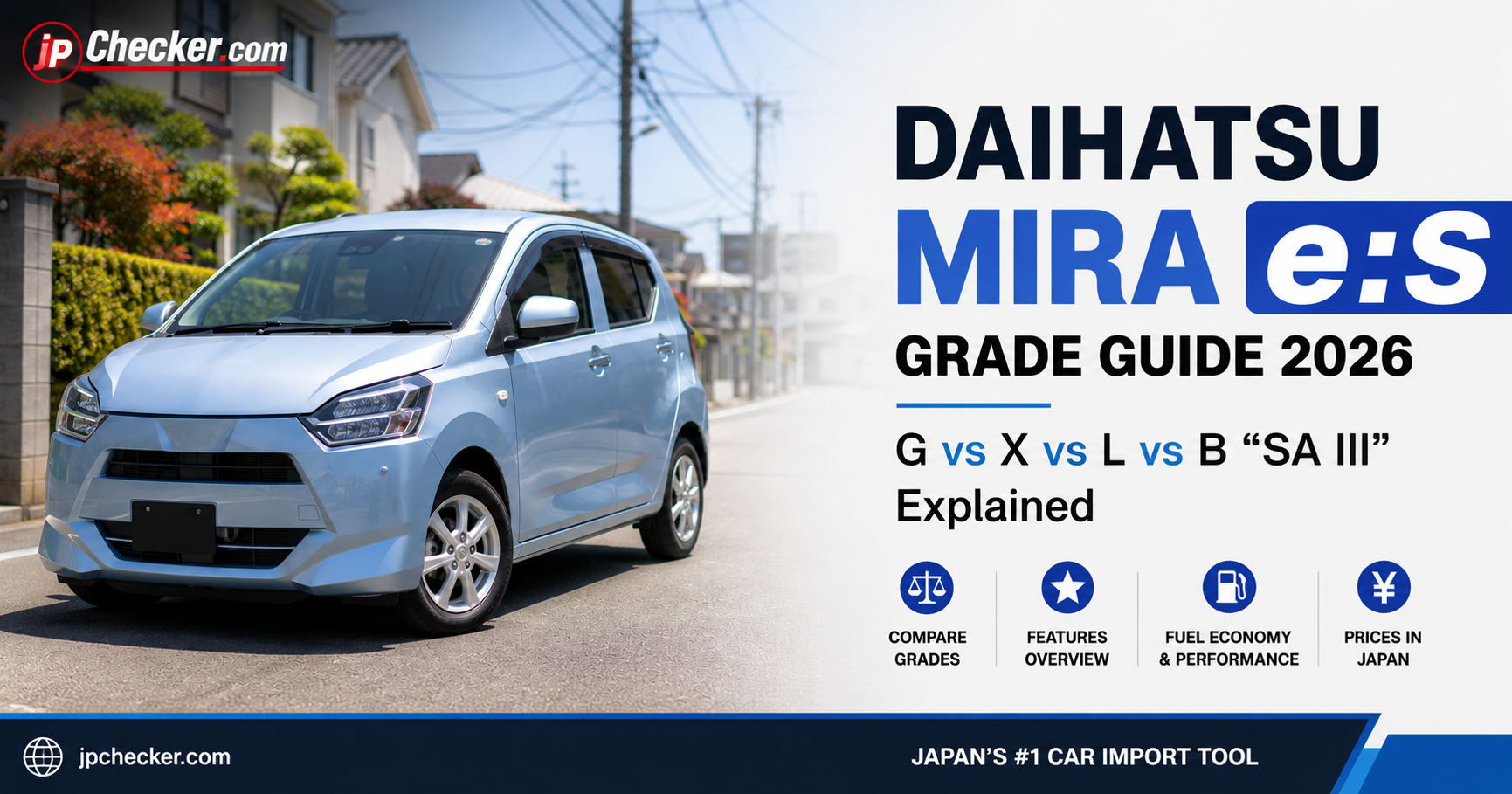
Daihatsu Mira e:S Grade Guide: G vs X vs L vs B "SA III" — All Differences Explained
Japan's original "third eco-car," decoded grade by grade. Four trims built entirely around one goal — the lowest possible running cost — with almost no differences in fuel economy between them. Here's exactly what your money actually buys at each grade, and which one is worth it.
📅 Current Model: Second-generation Mira e:S (since May 9, 2017, facelifted with Smart Assist III) 🚗 Grades: G "SA III" · X "SA III" · L "SA III" · B "SA III" 🇯🇵 Japan Domestic Market — 660cc Kei Car 🍃 Daihatsu's "Third Eco-Car" Concept, No Hybrid Needed
What Is the Daihatsu Mira e:S?
The Daihatsu Mira e:S (styled "Mira e:S," pronounced "Mira eeSu") launched in September 2011 with a simple pitch: excellent fuel economy and a low sticker price, achieved entirely through a lightweight gasoline engine and body — no hybrid battery, no electric motor. At launch it delivered 30.0 km/L on the JC08 cycle and broke the ¥800,000 price barrier, positioning itself as a "third eco-car" alongside hybrids and EVs, aimed squarely at value-focused daily drivers rather than performance-minded buyers.
The current, second-generation Mira e:S arrived with a full model change on May 9, 2017 — the model that established the design principles behind Daihatsu's later DNGA (Daihatsu New Global Architecture) platform, even though DNGA itself wasn't fully implemented on this generation. The redesign used a lightweight, high-rigidity "D-monocoque" body structure to cut up to 80 kg versus the outgoing model, while introducing Daihatsu's Smart Assist III collision-avoidance system for the first time on this nameplate — the reason every current grade carries the "SA III" suffix.
Unlike the Tanto or Move, the Mira e:S has no Custom or performance-oriented sub-line. All four grades — G, X, L, and B — share the same naturally aspirated 660cc engine and nearly identical fuel economy; the differences are almost entirely about equipment level and finish, not mechanicals.
Grade Lineup at a Glance
| Grade | Drive | From (JPY, tax incl.) | WLTC Fuel Economy | JC08 Fuel Economy |
|---|---|---|---|---|
| G "SA III" | 2WD / 4WD | ¥1,320,000 | 25.0 km/L (2WD) / 23.2 km/L (4WD) | 34.2 km/L (2WD) / 32.2 km/L (4WD) |
| X "SA III" | 2WD / 4WD | ¥1,179,200 | 25.0 km/L (2WD) / 23.2 km/L (4WD) | 34.2 km/L (2WD) / 32.2 km/L (4WD) |
| L "SA III" | 2WD / 4WD | ¥1,025,200 | 25.0 km/L (2WD) / 23.2 km/L (4WD) | 35.2 km/L (2WD) / 32.2 km/L (4WD) |
| B "SA III" | 2WD / 4WD | ¥992,200 | 25.0 km/L (2WD) / 23.2 km/L (4WD) | 35.2 km/L (2WD) / 32.2 km/L (4WD) |
Prices and fuel economy figures per Daihatsu's official Japan-market pricing page. Hokkaido-region pricing runs slightly higher across all grades due to cold-weather specification. Notice fuel economy barely changes across the range — the Mira e:S doesn't ask you to pay more for efficiency, only for equipment.
The Engine — One Powertrain, No Turbo Option
Every Mira e:S grade uses the same naturally aspirated 658cc three-cylinder KF-VE engine paired with a CVT, in either 2WD or 4WD. Unlike siblings such as the Tanto or Move, there's no turbocharged variant offered on this nameplate — the Mira e:S's entire value proposition is built around light weight and mechanical simplicity rather than outright performance, so there's nothing to compare on the engine side. Every grade decision comes down to equipment, not powertrain.
Full Grade Breakdown
G "SA III" — Top Grade
From ¥1,320,000 (2WD)
- 14-inch aluminum wheels
- LED headlamps (low/high beam, manual leveling, LED clearance lamps, auto light)
- Auto-retractable, body-colored door mirrors, linked to the key-free system
- Self-illuminating digital meter with blue illumination and chrome bezel, including a TFT multi-information display
- Automatic air conditioning (push-button)
- Key-free system with immobilizer and request switches on driver door, passenger door, and back door
The G is the only grade with true key-free entry (walk-up unlocking) and automatic climate control — the two biggest everyday-convenience upgrades in the range.
X "SA III" — Mid Grade
From ¥1,179,200 (2WD)
- 14-inch full wheel caps (versus G's genuine alloys)
- LED headlamps — identical spec to the G grade (low/high beam, manual leveling, LED clearance lamps, auto light)
- Power-retractable, body-colored door mirrors (not linked to key-free, since X uses keyless entry rather than key-free)
- Same self-illuminating digital meter with blue illumination and TFT multi-info display as the G
- Manual air conditioning (rotary dial)
- Keyless entry (not key-free)
The X keeps the G's LED headlamps and digital meter but trades the alloy wheels, key-free walk-up unlocking, and automatic climate control for a more basic (and cheaper) set of comfort features.
L "SA III" — Value Grade
From ¥1,025,200 (2WD)
- 13-inch full wheel caps
- Multi-reflector halogen headlamps (manual leveling, auto light) — no LED
- Manually foldable, black door mirrors (not powered)
- Self-illuminating digital meter with amber illumination and a simpler multi-information display (not the TFT unit used on G/X)
- Manual air conditioning (rotary dial)
- Keyless entry
The L is where LED headlamps disappear from the spec sheet — everything below this grade uses halogen lighting, and the digital meter loses its TFT screen for a simpler amber display.
B "SA III" — Basic/Business Grade
From ¥992,200 (2WD)
- 13-inch steel wheels with center caps (rather than L's full wheel caps)
- Multi-reflector halogen headlamps — identical to the L grade
- Manually foldable, black door mirrors — identical to the L grade
- Self-illuminating digital meter with amber illumination — identical to the L grade
- Manual air conditioning (rotary dial)
- Keyless entry
Daihatsu markets the B specifically for business and fleet use, describing it as offering "basic equipment and a thoughtfully designed cargo area, ideal for business use too." Equipment-wise it's nearly identical to the L grade — the only visible difference is the wheel type, with plain steel wheels replacing the L's full wheel caps.
Full Feature Comparison Table
| Feature | G "SA III" | X "SA III" | L "SA III" | B "SA III" |
|---|---|---|---|---|
| EXTERIOR | ||||
| Wheels | 14-in alloy | 14-in full wheel caps | 13-in full wheel caps | 13-in steel, center caps |
| Headlamps | LED (auto light) | LED (auto light) | Halogen (auto light) | Halogen (auto light) |
| Door mirrors | Auto-retractable, colored, key-free linked | Power-retractable, colored | Manual fold, black | Manual fold, black |
| INTERIOR | ||||
| Instrument display | Digital, blue illumination, TFT multi-info | Digital, blue illumination, TFT multi-info | Digital, amber illumination | Digital, amber illumination |
| Air conditioning | Automatic (push-button) | Manual (rotary dial) | Manual (rotary dial) | Manual (rotary dial) |
| Entry system | Key-free + immobilizer | Keyless entry | Keyless entry | Keyless entry |
| SAFETY | ||||
| Smart Assist III | ✓ | ✓ | ✓ | ✓ |
| Corner sensors (front/rear) | ✓ | ✓ | ✓ | ✓ |
✓ = Standard/Available. Features sourced from Daihatsu's official grade pages (daihatsu.co.jp/lineup/mira_e-s).
Which Grade Should You Buy?
💴 Best for Lowest Cost
Choose the B "SA III". It's within roughly ¥33,000 of the L grade in price but offers essentially the same equipment — the only real compromise is steel wheels with center caps rather than full wheel caps. If badge and fleet-style plainness don't bother you, this is the cheapest way into a brand-new Mira e:S.
⭐ Best Value
Choose the L "SA III". Full wheel caps for a marginally nicer look than the B, at a very small price premium, while keeping the same halogen lighting and simple amber-display meter as the entry grade.
🏆 Best for Everyday Convenience
Choose the X "SA III". LED headlamps and the TFT-equipped digital meter — both otherwise reserved for the top grade — arrive here for meaningfully less than the G, at the cost of manual air conditioning and alloy wheels.
🚀 Best Overall Specification
Choose the G "SA III". It's the only grade with genuine alloy wheels, key-free walk-up entry, and automatic climate control — the closest the Mira e:S gets to a "loaded" spec, while still remaining one of the least expensive new cars sold in Japan.
Importing a Daihatsu Mira e:S
For buyers sourcing a Mira e:S from Japanese auction, a few identification points matter:
- Wheel type is the fastest way to separate all four grades at a glance: 14-inch alloys mean G, 14-inch full wheel caps mean X, 13-inch full wheel caps mean L, and plain 13-inch steel wheels with center caps mean B.
- Headlamp type narrows it down further — LED headlamps rule out L and B, since only G and X carry them.
- Automatic climate control and a chrome-bezel digital meter with a TFT screen are G-exclusive; every other grade uses manual dial air conditioning.
- All four grades carry Smart Assist III as standard, so the presence or absence of the collision-avoidance system doesn't help distinguish grades — check the equipment sheet for details like corner sensors instead if that matters to your specific unit.
- Since the current generation dates to May 2017, older Mira e:S listings (pre-2017) belong to the first generation with a completely different grade structure (D/L/X/G plus 4WD "f" variants) and no Smart Assist III — confirm the model year before comparing equipment against this guide.
Always confirm the exact grade, drivetrain, and accident history against the chassis number before bidding, since equipment details are easy to misread from auction photos alone. If you're bidding from overseas, running the chassis number through a Japanese auction sheet and history check before you commit is the safest way to confirm the car in front of you actually matches the grade it's listed under — that's exactly the kind of check we built JPChecker to make simple.
Frequently Asked Questions
What is the cheapest Daihatsu Mira e:S grade? The B "SA III" is the entry point, starting from ¥992,200 (tax included) for the 2WD version — one of the least expensive new cars sold in Japan.
What is the difference between the Mira e:S B and L grades? Very little. Both use the same halogen headlamps, manual air conditioning, and amber-illuminated digital meter — the main visible difference is that L uses 13-inch full wheel caps while B uses plain 13-inch steel wheels with center caps.
Does any Mira e:S grade have a turbo engine? No. All four grades share the same naturally aspirated 658cc engine — Daihatsu doesn't offer a turbocharged Mira e:S, unlike some other kei models in its lineup such as the Tanto or Move.
Which Mira e:S grade has LED headlamps? Only the G "SA III" and X "SA III" grades get LED headlamps. The L "SA III" and B "SA III" use halogen headlamps instead.
Does the Mira e:S have key-free entry? Only the top G "SA III" grade includes key-free (walk-up unlock) entry with an immobilizer. The X, L, and B grades use conventional keyless entry instead.
What does "SA III" mean on a Mira e:S? "SA III" refers to Smart Assist III, Daihatsu's third-generation collision-avoidance and driver-assistance system, first fitted to the Mira e:S with the May 2017 full model change. It includes pedestrian-detection collision braking, lane-departure warning, and Japan's first kei-car application of front and rear corner sensors.
Is the Mira e:S a hybrid? No. Despite its "eco-car" positioning and the "e:S" name, the Mira e:S achieves its fuel economy through a lightweight body and efficient naturally aspirated engine rather than any form of hybrid or electric assistance.