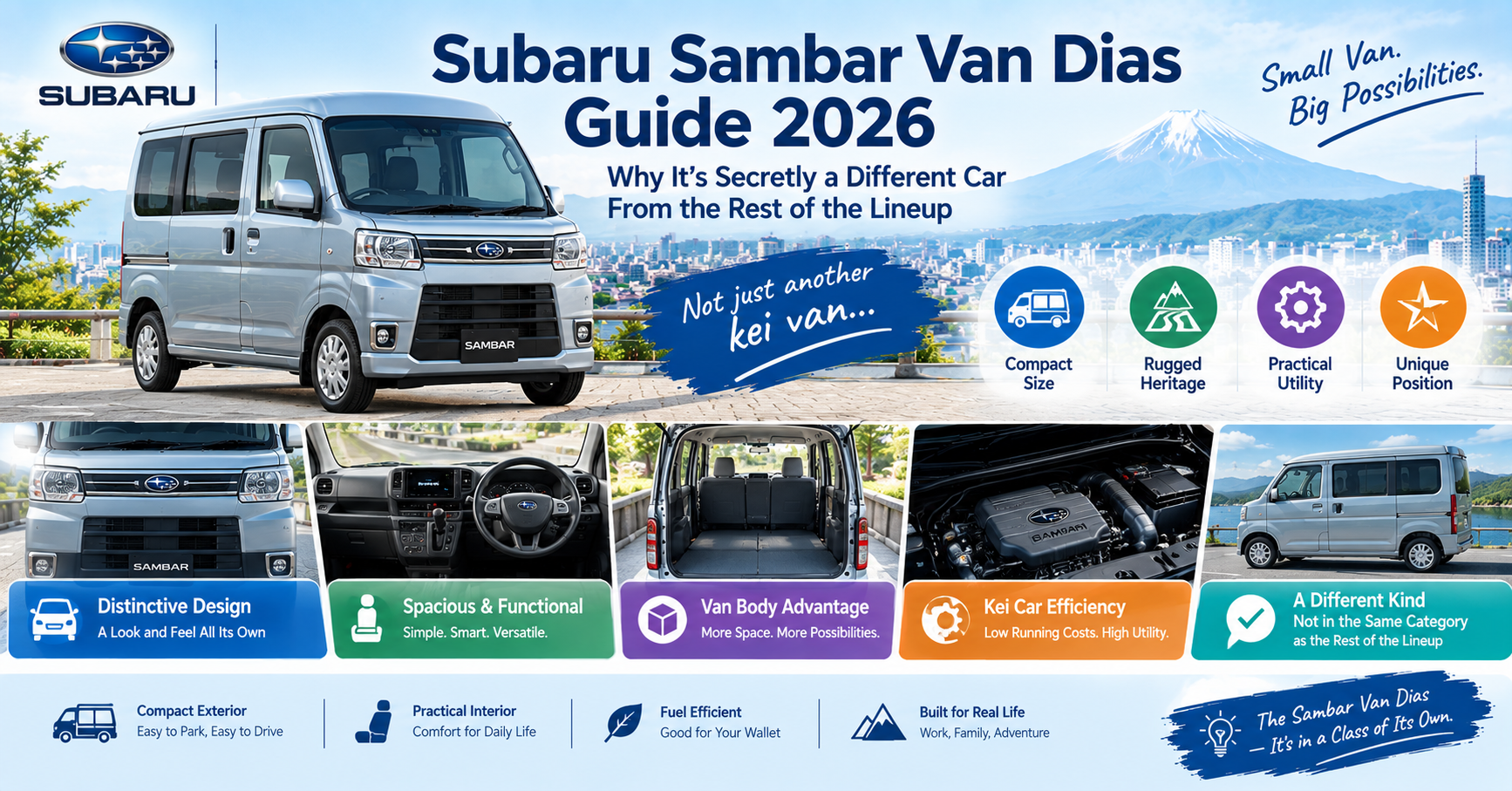
Subaru Sambar Van Dias Guide: Why It's Secretly a Different Car From the Rest of the Lineup
Every other grade in the Sambar Van range is a badge-engineered Daihatsu Hijet Cargo. Dias isn't. Here's the genuinely surprising story behind Subaru's leisure-focused kei van, what it costs, and how it fits into the wider six-grade Sambar Van lineup.
📅 8th-generation Sambar Van: Since January 13, 2022 🚗 Grades: VB · VB Clean · Transporter · VC · VC Turbo · Dias 🇯🇵 Japan Domestic Market — 660cc Kei Van 🔀 Dias Is OEM'd From a Different Daihatsu Model Than Every Other Grade
The Twist: Dias Isn't a Hijet Cargo Underneath
Here's the detail that makes Dias genuinely worth its own guide rather than just being "the top Sambar Van trim": every other grade in the current Sambar Van lineup — VB, VB Clean, Transporter, VC, and VC Turbo — is a badge-engineered version of the Daihatsu Hijet Cargo. Dias alone is different. In this eighth generation, Dias is OEM-sourced from the Daihatsu Atrai instead — a related but distinct Daihatsu cab-over kei model with its own more leisure-and-lifestyle-oriented positioning, separate from Hijet Cargo's work-van focus. If you've noticed Dias looking and feeling meaningfully different from the rest of the Sambar Van range — different lighting details, a different design language, a more leisure-oriented equipment list — this is why: it's genuinely a different underlying vehicle wearing the same Sambar Van nameplate.
Fifty-One Years of Self-Production, Then a Complete Switch to Daihatsu
Sambar's history explains why this OEM arrangement exists at all. Subaru built Sambar in-house continuously from February 1961 until February 28, 2012 — 51 years, making it one of Japan's longest-running continuously self-produced kei vehicle lines. The self-built Sambar was known for a distinctive rear-engine, rear-wheel-drive (RR) layout with four-wheel independent suspension, a genuinely unusual engineering choice by the end of its production run, when Sambar had become the only kei truck still offering a supercharged/turbocharged engine option in its class.
Subaru ended all self-production of kei vehicles in 2012 as part of a broader business realignment, switching entirely to Daihatsu OEM supply. The seventh-generation Sambar Van launched April 2, 2012, about a month after the sixth generation's production ended, based on the 10th-generation Daihatsu Hijet Cargo. That seventh generation ran until November 30, 2021, when — following the same timeline as its Hijet Cargo donor vehicle — orders and production ended ahead of the current, eighth-generation Sambar Van, which launched January 13, 2022, about three weeks after Hijet Cargo's own full model change.
Grade Lineup at a Glance
| Grade | Transmission | Price (JPY, tax incl., 2WD) | Price (JPY, tax incl., 4WD) |
|---|---|---|---|
| VB | MT / CVT | ¥1,155,000 (MT) / ¥1,210,000 (CVT) | ¥1,309,000 (MT) / ¥1,364,000 (CVT) |
| VB Clean | CVT | ¥1,232,000 | ¥1,386,000 |
| Transporter | MT / CVT | ¥1,270,500 (MT) / ¥1,386,000 (CVT) | ¥1,424,500 (MT) / ¥1,540,000 (CVT) |
| VC | MT / CVT | ¥1,353,000 (MT) / ¥1,666,500 (CVT) | ¥1,507,000 (MT) / ¥1,820,500 (CVT) |
| VC Turbo | CVT only | ¥1,798,500 | ¥1,952,500 |
| Dias | CVT only | ¥1,914,000 | ¥2,068,000 |
Prices per Subaru's official Japan-market pricing. Notice that Dias is priced above VC Turbo, despite Dias apparently not using a turbocharged engine — its equipment and styling premium (as the Atrai-based leisure grade) exceeds what the turbo engine itself commands elsewhere in the range.
Full Grade Breakdown
VB — Base Grade
From ¥1,155,000 (2WD, MT)
- Smart Assist (collision-avoidance support, recognition support, parking support)
- Unpainted black front and rear bumpers
- Multi-reflector halogen headlamps
- Multi-information display
- Manual air conditioning (rotary dial)
- Front door power windows with a driver's-side reversal switch
- Power door locks (linked across all doors and rear gate)
- AM/FM radio
- Printed leather-look seats
- Bench-type, horizontally-folding rear seat
- Center upper tray
- Useful nuts (bolt-on accessory mounting points, no drilling required)
VB Clean — Low-Emission Variant
From ¥1,232,000 (2WD, CVT only)
- Same core equipment as VB
- Positioned specifically around balancing base performance with low fuel consumption and low emissions
Transporter — Comfort-Focused Work Grade
From ¥1,270,500 (2WD, MT)
Adds over VB/VB Clean:
- LED fog lamps with chrome bezel (CVT models only)
- Colored front bumper
- Dark-tinted UV-cut glass (sliding door, rear quarter, rear gate)
- LED high and low beam headlamps (CVT models only)
- Radio-wave remote door lock with answer-back function
- Full fabric seats (front seats water-repellent treated)
- Side sill plate (front door)
- Overhead shelf
- LED room lamp and LED cargo room lamp (CVT models only)
- Adaptive Driving Beam and Side View Lamp, both Smart Assist recognition-support features (CVT models only)
VC — Upper Work/Daily-Use Grade
From ¥1,353,000 (2WD, MT)
Adds over Transporter:
- Power-folding, body-colored door mirrors
- Super UV & IR-cut glass (front doors)
- Power sliding doors, both sides (CVT models only)
- Slide door easy closer, both sides (CVT models only)
- Foot-operated parking brake (CVT models only)
- Audio-less specification with 16cm front speakers
- Full fabric seats (front and rear water-repellent treated)
- Separate-type, horizontally-folding rear seats
- Rear glass with pop-up mechanism (CVT models only)
- Driver's vanity mirror
- Passenger seatback pocket
- Large LED cargo room lamp
- 12-inch full wheel caps
VC Turbo — Performance Grade
¥1,798,500 (2WD, CVT only)
- The turbocharged engine option, exclusive to this grade
- All VC-grade equipment as standard (rather than CVT-only conditional items), including both-side power sliding doors, foot parking brake, and the full lighting/glass package
Dias — Leisure-Focused Flagship (Atrai-Based)
From ¥1,914,000 (2WD, CVT only)
- LED high and low beam headlamps with a chrome front grille
- LED fog lamps (chrome bezel) with a black front lower bumper
- Clear rear combination lamps (LED tail and stop lamps) with a black rear bumper garnish
- 12-inch full wheel caps with a black side sill spoiler
- Power-folding, black-colored door mirrors with turn-signal indicators
- Power sliding doors, both sides
- Active Multi Information Meter
- Automatic air conditioning
- Cargo room accessory socket (12V)
- Steering-mounted audio switches, GPS antenna, full-segment TV film antenna
- Front center armrest
- Instrument panel center pocket
- Deck-side trim with slits, allowing dealer-option luggage boards, storage racks, or a fold-out work table to be fitted into the slits
- Deck-side pockets (left and right)
- Easy-care mat on the rear seatback and cargo room floor, wipeable and suited to outdoor, marine, or gardening gear (not fully waterproof — water can still reach the floor beneath or the seats depending on use)
- Multi-hooks (two included), for flexible cargo-area organization in combination with dealer-option cargo hooks
- Smart Assist (driving-load reduction focus)
Dias also includes a horizontally-folding rear seat that tucks into the footwell space, expanding the cargo area into a genuinely flat, wide space usable for rest breaks or sleeping in the vehicle during outdoor trips — a feature Subaru markets specifically around leisure use rather than commercial cargo hauling.
Full Feature Comparison Table
| Feature | VB / VB Clean | Transporter | VC | VC Turbo | Dias |
|---|---|---|---|---|---|
| DONOR VEHICLE | Hijet Cargo | Hijet Cargo | Hijet Cargo | Hijet Cargo | Atrai |
| POWERTRAIN | |||||
| Transmission | MT or CVT | MT or CVT | MT or CVT | CVT only | CVT only |
| Turbo engine | ✗ | ✗ | ✗ | ✓ | Not specified as standard |
| DOORS | |||||
| Power sliding doors (both sides) | ✗ | ✗ | ✓ (CVT only) | ✓ | ✓ |
| EXTERIOR | |||||
| Headlamps | Halogen | LED (CVT only) | LED | LED | LED, chrome grille |
| Fog lamps | ✗ | ✓ (CVT only) | — | — | ✓ chrome bezel |
| INTERIOR | |||||
| Seats | Printed leather-look | Full fabric | Full fabric, water-repellent | Full fabric, water-repellent | Dias-specific full fabric |
| Meter | Multi-info display | Multi-info display | Multi-info display | Multi-info display | Active Multi Information Meter |
| Air conditioning | Manual | Manual | Manual | Manual | Automatic |
| Cargo-area leisure equipment (deck-side trim, easy-care mat, multi-hooks) | ✗ | ✗ | ✗ | ✗ | ✓ |
✓ = Standard/Available | ✗ = Not offered | — = Carried over from prior grade, not separately itemized. Features sourced directly from Subaru's official grade pages (subaru.jp/sambar-van).
Which Grade Should You Buy?
💴 Best for Lowest Cost
Choose VB or VB Clean. Smart Assist and genuinely functional basics (power windows, power door locks, a multi-info display) are standard even here.
⭐ Best Value for Daily Work Use
Choose Transporter. LED lighting and fabric seats meaningfully improve on VB without paying VC's premium.
🚪 Best for Both-Side Sliding Doors on a Budget
Choose VC. It's the most affordable grade with both-side power sliding doors (on CVT models), plus a genuinely more complete comfort and lighting package.
🚀 Best for Performance
Choose VC Turbo. The only grade with the turbocharged engine, with VC's full equipment standardized rather than conditional on transmission choice.
🏕️ Best for Leisure and Outdoor Use
Choose Dias. It's built from a different donor vehicle (Atrai) specifically to support a leisure-oriented use case — chrome exterior details, automatic air conditioning, and genuinely thoughtful cargo-area features like the slitted deck-side trim, easy-care mat, and multi-hooks that no other Sambar Van grade offers.
Importing a Subaru Sambar Van Dias
For buyers sourcing a Sambar Van Dias from Japanese auction, a few identification points matter:
- Confirm you're evaluating genuine Dias-specific styling — chrome grille, chrome fog lamp bezels, black lower bumper and rear bumper garnish, and a black side sill spoiler are Dias-exclusive, not shared with VC Turbo or lower grades.
- Remember Dias is Atrai-based, not Hijet-Cargo-based, on this generation specifically — if you're cross-referencing parts, dimensions, or history against Hijet Cargo information (as you reasonably would for every other Sambar Van grade), confirm you're instead looking at Daihatsu Atrai data for a Dias-specific question.
- Automatic air conditioning confirms Dias — every other current grade uses manual, dial-type air conditioning.
- Deck-side trim with slits, an easy-care mat, and multi-hooks are Dias-exclusive cargo features — useful confirmation points if photos show the cargo area.
- Confirm generation carefully: an 8th-generation Sambar Van (January 2022 onward) is a different vehicle from the 7th generation (2012–2021), which was Hijet-Cargo-based across its entire range, including its own Dias-equivalent trim — the Atrai-based Dias arrangement is specific to this current generation.
Always confirm the exact grade, donor-vehicle basis, transmission, drivetrain, and accident/usage history against the chassis number before bidding, since equipment and even the underlying donor vehicle can differ between grades on this specific nameplate in ways that aren't obvious from casual inspection. If you're bidding from overseas, running the chassis number through a Japanese auction sheet and history check before you commit is the safest way to confirm the vehicle in front of you actually matches what it's listed as — that's exactly the kind of check we built JPChecker to make simple.
Frequently Asked Questions
Is the Subaru Sambar Van Dias the same as the Daihatsu Hijet Cargo? No, not in the current generation. While every other Sambar Van grade (VB, VB Clean, Transporter, VC, VC Turbo) is OEM-sourced from the Daihatsu Hijet Cargo, Dias specifically is OEM-sourced from the Daihatsu Atrai — a related but distinct Daihatsu model with its own leisure-oriented positioning.
How much does the Subaru Sambar Van Dias cost? From ¥1,914,000 (tax included) for the 2WD CVT version — notably more expensive than even the turbocharged VC Turbo grade, reflecting Dias's distinct equipment and styling rather than raw engine performance.
Does the Sambar Van Dias have a turbo engine? This isn't specified as standard equipment in Subaru's official materials, unlike VC Turbo, which explicitly offers a turbocharged engine as its defining feature.
What is unique about the Dias grade's cargo area? Dias includes deck-side trim with slits (for dealer-option luggage boards or a fold-out table), an easy-care wipeable mat on the rear seatback and cargo floor, and included multi-hooks for cargo organization — none of which are available on any other Sambar Van grade.
Why did Subaru stop building its own Sambar? Subaru ended in-house production of all kei-class vehicles in 2012 as part of a broader business realignment, after 51 years of self-produced Sambar vans and trucks. Since April 2012, Sambar has been OEM-supplied by Daihatsu, based on the Hijet Cargo (and, for Dias specifically, the Atrai).
What is the current Sambar Van generation? The eighth generation, which launched January 13, 2022, about three weeks after its Daihatsu Hijet Cargo donor vehicle's own full model change.
Does the Sambar Van still offer an open-deck (Deck Van) version? No. The open-deck "Sambar Van Open Deck" variant, based on the Hijet Cargo Deck Van, was offered on the previous (seventh) generation but was discontinued and not carried over to the current eighth generation.