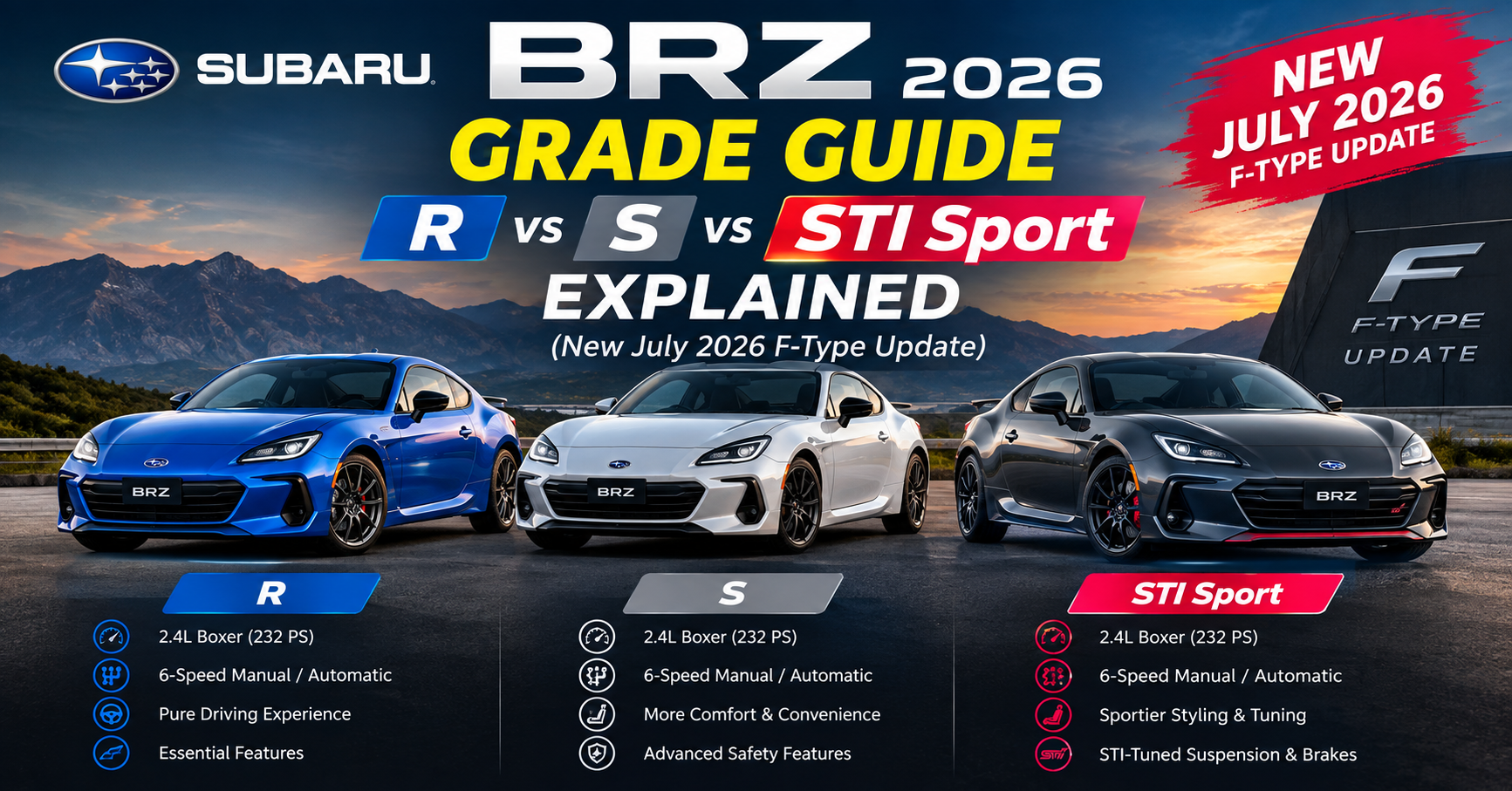
Subaru BRZ Grade Guide: R vs S vs STI Sport — All Differences Explained
Subaru's pure, lightweight FR sports coupe just got its most technically significant safety update since launch — a genuine first for any Subaru manual-transmission car. Here's exactly what changed on July 30, 2026, how R, S, and STI Sport compare, and how BRZ relates to its Toyota GR86 twin.
📅 Current Model: 2nd-generation BRZ (ZD8), full model change July 2021, latest update "F-type," July 30, 2026 🚗 Grades: R · S · STI Sport 🇯🇵 Japan Domestic Market — Co-Developed With Toyota, Built Alongside GR86 🏁 2.4L Naturally Aspirated Boxer Engine, 235 PS
Breaking: A Genuine First for Subaru's Manual Cars (July 30, 2026)
Subaru announced the "F-type" running update to BRZ on July 30, 2026 — about two months before this guide's publication. The headline change is safety-technology news, not a power upgrade: this is the first time Subaru has fitted a wide-angle monocular camera to EyeSight on a manual-transmission car, a genuine engineering first rather than a routine equipment refresh. Alongside it, Subaru revised the manual shift lever structure using knowledge gained from its Super Taikyu endurance racing program, and made further chassis refinements. The 2.4L engine itself carries over unchanged. Toyota's mechanically identical GR86 is scheduled to receive the equivalent update on August 6, 2026, a week later — a reminder of just how tightly these two cars' development remains linked, even six years after their joint launch.
What Does "BRZ" Even Stand For?
Since it comes up often: Boxer engine, Rear-wheel drive, Zenith (meaning "ultimate") — Subaru's own explanation for the name, reflecting the car's entire design philosophy in three words.
What Is the Subaru BRZ?
BRZ is a compact, lightweight, rear-wheel-drive sports coupe co-developed by Subaru and Toyota, with Toyota selling the mechanically near-identical car as the GR86 (formerly badged simply "86"). Both are built on the same production line at Subaru's Gunma plant — genuinely the same car assembled side by side, not just shared engineering on paper. The current second generation had its full model change in July 2021, growing the engine from the previous generation's 2.0L to the current 2.4L, with a 15% torque increase over the outgoing unit, deepening what Subaru describes as "the ultimate FR pure sports car anyone can enjoy." Since that full model change, BRZ has received running updates and special editions at a pace of roughly once a year — this July 2026 F-type is simply the latest in that steady cadence.
Grade Lineup at a Glance
| Grade | Transmission | Price (JPY, tax incl.) | WLTC Fuel Economy |
|---|---|---|---|
| R | 6MT | ¥3,377,000 | 12.0 km/L |
| R | 6AT | ¥3,410,000 | 11.8 km/L |
| S | 6MT | ¥3,564,000 | 11.9 km/L |
| S | 6AT | ¥3,597,000 | 11.7 km/L |
| STI Sport | 6MT | ¥3,839,000 | 11.9 km/L |
| STI Sport | 6AT | ¥3,872,000 | 11.7 km/L |
Prices per Subaru's official Japan-market pricing following the July 2026 F-type update. S and STI Sport show slightly lower fuel economy than R, reflecting their larger 18-inch high-performance tires versus R's 17-inch wheels.
The Engine — Unchanged, and Deliberately So
Every BRZ grade uses the same FA24-type 2.4L horizontally-opposed (boxer) 4-cylinder engine, combining direct and port fuel injection (Toyota's D-4S system):
- Output: 235 PS (173 kW) @ 7,000 rpm / 250 Nm (25.5 kgf·m) @ 3,700 rpm
- Requires unleaded premium gasoline
- Naturally aspirated — no turbo, delivering the direct, linear throttle response and rev-happy character (revving cleanly to 7,000 rpm) that defines this car's driving character
- Paired with a genuine 6-speed manual or 6-speed automatic
- Curb weight around 1,260–1,270 kg, contributing to the light, agile handling both BRZ and GR86 are known for
This specification hasn't changed since the July 2021 full model change, and the July 2026 F-type update deliberately left it untouched — the update is about safety technology and chassis refinement, not more power.
Full Grade Breakdown
R — Standard Grade
From ¥3,377,000 (MT)
- 215/45R17 tires with 17-inch aluminum wheels (Super Black Hi-Luster finish)
- Full LED headlamps with steering-linked function
- Leather-wrapped steering wheel (high-tactile leather, red stitching, dark cast metallic accent)
- Leather-wrapped shift knob (MT) or shift lever (AT)
- Aluminum-pad sport pedals
- Full automatic air conditioning with independent left/right temperature control
- BOXER meter (7-inch color plus LCD display)
- 6 speakers (4 front + 2 rear)
- Fabric seats with red stitching
- Driver's and passenger's vanity mirrors
- USB power (2 ports in the console box)
- Subaru Rear Vehicle Detection, VSC (VDC)
S — Upper Grade
From ¥3,564,000 (MT)
Adds over R:
- 215/40R18 high-performance tires with 18-inch aluminum wheels (matte dark gray metallic)
- 8 speakers (6 front + 2 rear + amplifier)
- Ultrasuede®/leather seats with red stitching and red accents
- Front seat heaters
- Upgraded meter visor material (Brannob®)
- Chrome-plated power window switches
- Stainless steel side sill plates
- Illuminated vanity mirrors, door courtesy lamps
STI Sport — Top Grade
From ¥3,839,000 (MT)
Adds over S:
- STI-tuned Astemo SFRD front dampers and STI-tuned rear dampers — a genuine suspension-hardware difference, not just cosmetic
- 18-inch aluminum wheels in a different dark metallic finish
- Full LED headlamps with a "BRZ" cherry-red letter mark
- Power-folding remote door mirrors, specifically in Crystal Black Silica
- BOXER meter with Bordeaux ring accent and STI logo
- Push engine start switch with STI logo, red type
- Shark-fin-type roof antenna, Crystal Black Silica
- Ultrasuede®/leather seats in black/bordeaux with red stitching, black accents, and STI logo embroidery
- STI emblems, front and rear
- Optional: brembo 17-inch front and rear ventilated disc brakes with gold calipers (manufacturer option)
A Practical Note on the STI Sport's Optional Brembo Brakes
Subaru's own documentation carries two specific caveats worth knowing before ordering the brembo brake option: first, order availability may end due to parts supply constraints — this isn't guaranteed to remain orderable indefinitely. Second, Subaru states directly that these high-performance calipers and pads tend toward more brake noise, squeal, and brake dust than standard brakes, and that paint discoloration or peeling on the calipers is possible depending on usage conditions. None of this means the option isn't worth having if you want the strongest braking performance available, but it's a genuine trade-off Subaru itself flags rather than a defect to be surprised by later.
Full Feature Comparison Table
| Feature | R | S | STI Sport |
|---|---|---|---|
| CHASSIS | |||
| Wheels/tires | 17-in, 215/45R17 | 18-in, 215/40R18 | 18-in, 215/40R18 |
| STI-tuned dampers | ✗ | ✗ | ✓ |
| Brembo brakes (option) | ✗ | ✗ | ✓ |
| EXTERIOR | |||
| Headlamp details | Full LED, steering-linked | Full LED, steering-linked | Full LED, steering-linked, "BRZ" red letter mark |
| Door mirrors | Standard colored | Standard colored | Power-folding, Crystal Black Silica |
| INTERIOR | |||
| Seats | Fabric, red stitching | Ultrasuede®/leather, red stitching + red accent | Ultrasuede®/leather, black/bordeaux, STI logo |
| Seat heaters | ✗ | ✓ | ✓ |
| Speakers | 6 | 8 | 8 |
| Meter | BOXER meter, standard | BOXER meter, standard | BOXER meter, Bordeaux ring + STI logo |
| SAFETY (all grades, post-July 2026) | |||
| EyeSight with wide-angle monocular camera (MT cars) | ✓ | ✓ | ✓ |
✓ = Standard/Available | ✗ = Not offered. Features sourced directly from Subaru's official grade pages (subaru.jp/brz), current through the July 2026 F-type update.
BRZ vs GR86 — What's Actually Different
Since these two cars share so much, here's the concise version: the engine is identical — same FA24 2.4L, same 235 PS / 250 Nm output, same 1,260–1,270 kg weight range, built on the same Gunma production line. What differs is suspension spring rates and damper characteristics, standard equipment selection, grade structure, and price. As a rough anchor, GR86's entry grade (RC) starts around ¥2,936,000, versus BRZ's entry grade (R) from ¥3,377,000 — Toyota's version has historically undercut Subaru's at the entry point, while equipment and suspension tuning differences run throughout the rest of each brand's respective grade range.
What's Coming After This: A Very Different Third Generation
Rumors reported in Japanese automotive press suggest Toyota may take the lead on developing a third-generation BRZ/GR86 for around 2028, potentially featuring a turbocharged engine paired with a new THS-based hybrid system, with output reportedly exceeding 300 PS — a significant departure from the current naturally aspirated formula — alongside a wider, lower-slung body. None of this is officially confirmed by Subaru or Toyota as of this writing, and should be treated as speculative industry reporting rather than an announced product plan. If accurate, the current July 2026 F-type update may represent close to the final form of this specific naturally aspirated, 2.4L generation before a much bigger change eventually arrives.
Which Grade Should You Buy?
💴 Best for Purists
Choose R. It's the lightest-optioned grade, with the smallest (17-inch) wheels — some enthusiasts specifically prefer this for slightly reduced unsprung weight and a marginally more compliant ride, alongside the lowest price in the range.
⭐ Best Value
Choose S. Ultrasuede®/leather seating, seat heaters, and the larger 18-inch wheel/tire package meaningfully lift the day-to-day experience over R for a reasonable price step.
🏆 Best for Driving Dynamics
Choose STI Sport. The STI-tuned dampers are a genuine hardware difference that changes how the car handles, not just a trim upgrade — pair it with the optional brembo brakes if you want the strongest braking performance available and can accept the trade-offs Subaru itself discloses.
Importing a Subaru BRZ
For buyers sourcing a BRZ from Japanese auction, a few identification points matter:
- A wide-angle monocular EyeSight camera on a manual-transmission car confirms a post-July-2026 (F-type) build — this was the specific first introduced with this update.
- STI-tuned dampers, a "BRZ" cherry-red headlamp letter mark, and Crystal Black Silica power-folding mirrors confirm STI Sport — neither R nor S carries any of these.
- Gold brembo calipers indicate the optional brake package on STI Sport — confirm this was factory-fitted rather than aftermarket, since it's a manufacturer option rather than standard equipment even on the top grade.
- Confirm generation carefully: this is the second-generation BRZ (ZD8, since July 2021) — an earlier first-generation BRZ (ZC6, 2012–2021) used the smaller 2.0L engine and is a mechanically different car despite sharing the same name.
- This is genuinely built alongside the Toyota GR86 on the same production line — cross-referencing GR86 information can be useful for general platform questions, but confirm BRZ-specific suspension tuning, equipment, and pricing independently, since these differ meaningfully between the two brands.
Always confirm the exact grade, transmission, generation, and accident/track-use history against the chassis number before bidding, since equipment details — especially which running-update year a car was built to — are easy to misread from auction photos alone. If you're bidding from overseas, running the chassis number through a Japanese auction sheet and history check before you commit is the safest way to confirm the car in front of you actually matches the grade it's listed under — that's exactly the kind of check we built JPChecker to make simple.
Frequently Asked Questions
What changed in the Subaru BRZ's July 2026 update? The main change was fitting a wide-angle monocular camera to EyeSight on manual-transmission cars — a first for Subaru — alongside a revised manual shift lever structure informed by Super Taikyu endurance racing experience, and further chassis refinement. The 2.4L engine itself was not changed.
What does BRZ stand for? Boxer engine, Rear-wheel drive, Zenith (meaning "ultimate") — Subaru's own explanation of the name.
Is the Subaru BRZ the same as the Toyota GR86? Mechanically, almost entirely — both use the identical 2.4L, 235 PS boxer engine and are built on the same production line at Subaru's Gunma plant. The differences are in suspension spring rates and damper tuning, standard equipment, grade structure, and price.
What is the cheapest Subaru BRZ grade? The R grade with a manual transmission, priced from ¥3,377,000 (tax included) as of the July 2026 update.
What is the difference between BRZ S and STI Sport? STI Sport adds STI-tuned front and rear dampers (a genuine suspension hardware difference), a "BRZ" cherry-red headlamp accent, power-folding door mirrors in a specific dark color, STI-branded interior trim, and the option of brembo brakes — none of which S offers.
Does the BRZ have a turbo engine? No, not in the current generation. Every grade uses the same naturally aspirated 2.4L boxer engine. Reports suggest a future third generation may introduce a turbocharged hybrid system, but this hasn't been officially confirmed.
Is a new generation of BRZ coming? Industry reporting suggests a third generation may arrive around 2028, potentially led by Toyota's development team and featuring a turbocharged hybrid powertrain exceeding 300 PS, but this has not been officially confirmed by Subaru or Toyota.