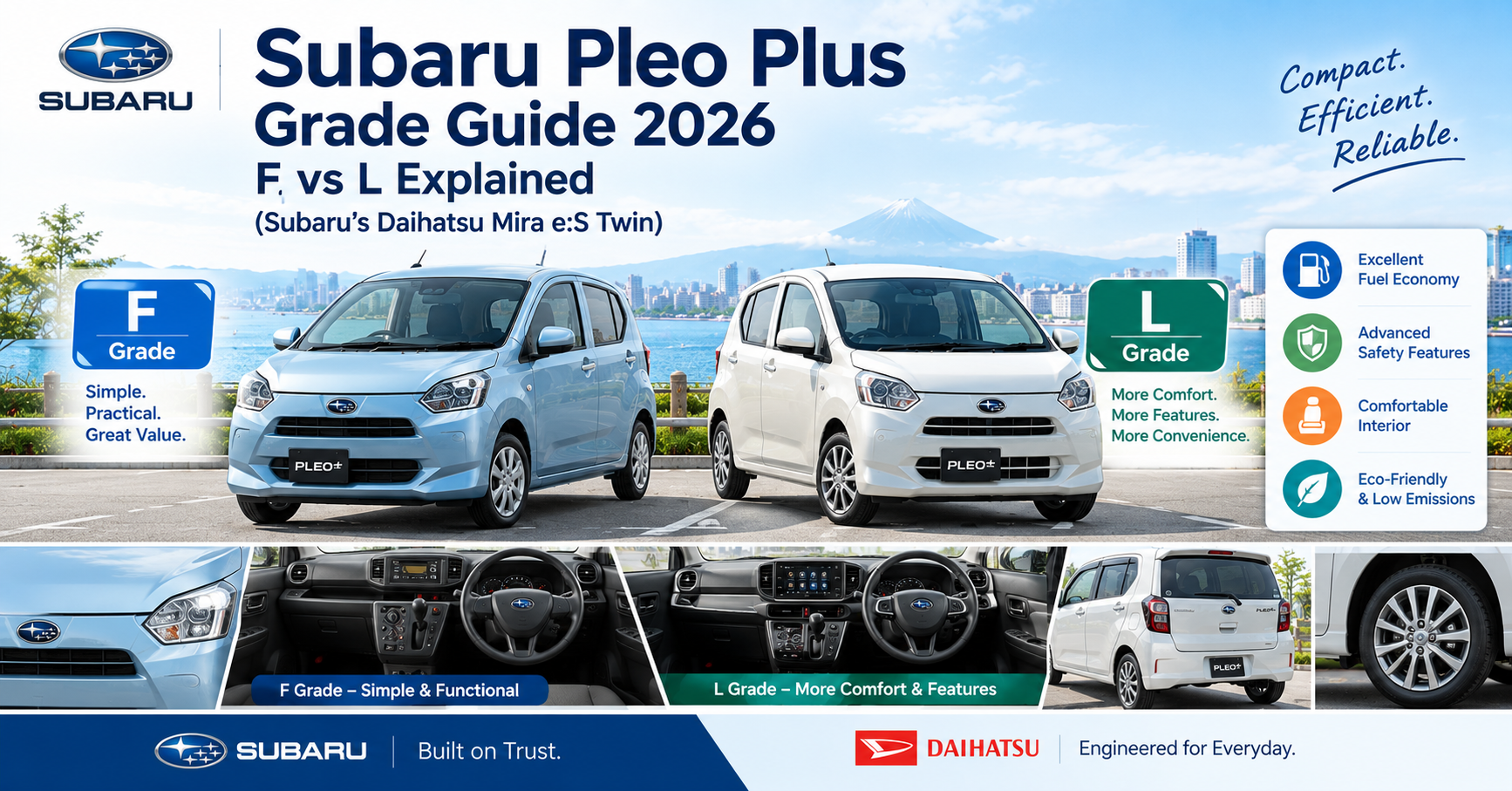
Subaru Pleo Plus Grade Guide: F vs L — All Differences Explained
Subaru hasn't designed its own kei car since 2010 — everything wearing a Subaru badge in this class today comes from Daihatsu. Pleo Plus is the current result: a two-grade, genuinely simple lineup built entirely around the Daihatsu Mira e:S underneath. Here's exactly what separates F and L, and the full story of how Subaru ended up selling someone else's kei car.
📅 Current Model: 2nd-generation Pleo Plus (LA350F/360F), since May 9, 2017 🚗 Grades: F · L 🇯🇵 Japan Domestic Market — 660cc Kei Car 🏭 Manufactured Entirely by Daihatsu, Badged as Subaru
Why Subaru Sells a Daihatsu-Built Kei Car
In April 2008, as part of a broader business consolidation following its switch of alliance partner from GM to Toyota in 2005, Subaru withdrew from independently developing and manufacturing kei cars, choosing instead to switch entirely to OEM supply from Daihatsu. The last genuinely Subaru-engineered kei car was the first-generation Pleo, sold from 1998 to 2010 and positioned as a rival to the Suzuki Wagon R, with a genuinely sporty "RS" variant that had real driving-enthusiast credibility. The second-generation Pleo (2010–2018) switched to being a badge-engineered version of the Daihatsu Mira — and, notably, the CVT-only version of that Mira-based Pleo effectively marked the end of manual-transmission kei cars under the Subaru badge, since a 5-speed manual "F Special" grade was consolidated away in February 2013 as the range moved to Pleo Plus.
Pleo Plus launched December 21, 2012 as a separate derivative specifically OEM'd from Daihatsu's Mira e:S — matching Daihatsu's own "third eco-car" positioning around low price and exceptional fuel economy. When the standard (non-Plus) Pleo was discontinued in March 2018 following the end of Daihatsu Mira production, Pleo Plus became the only Pleo variant Subaru sells — a state that continues today.
The Current Generation: A Direct Mira e:S Twin
The current, second-generation Pleo Plus (chassis code LA350F/360F) launched May 9, 2017 — the exact same date as the second-generation Daihatsu Mira e:S it's built from. If you've read our Daihatsu Mira e:S guide, the underlying vehicle here is identical: same D-monocoque lightweight body structure, same Smart Assist collision-avoidance technology, same naturally aspirated 658cc engine. What differs is exclusively the badge, some styling and trim details, and — notably — how many grades Subaru chooses to offer.
Grade Lineup at a Glance
| Grade | Drive | Price (JPY, tax incl.) | WLTC Fuel Economy |
|---|---|---|---|
| F | 2WD / 4WD | ¥1,107,700 (2WD) / ¥1,234,200 (4WD) | 27.0 km/L (2WD) / 24.4 km/L (4WD) |
| L | 2WD / 4WD | ¥1,256,200 (2WD) / ¥1,382,700 (4WD) | 27.0 km/L (2WD) / 24.4 km/L (4WD) |
Prices per Subaru's official Japan-market pricing. Fuel economy is identical across both grades — as with the Daihatsu Mira e:S, Pleo Plus doesn't ask you to pay more for efficiency, only for equipment. Subaru also prominently offers residual-value credit financing (残価設定型クレジット) on Pleo Plus, with example monthly payments starting from ¥5,300 (F, 2WD) up to ¥6,600 (L, 4WD) over 36 months with a bonus-payment structure — worth knowing if financing is part of your buying decision.
Just Two Grades — A Deliberately Simpler Lineup Than Daihatsu's Own
Here's a detail worth understanding if you're cross-shopping with the Daihatsu original: Daihatsu sells the Mira e:S across four grades (G, X, L, B), but Subaru offers Pleo Plus in only two (F, L). Subaru hasn't imported Daihatsu's full grade spread — it's deliberately curated a simpler, two-tier lineup. If you're trying to map Subaru's F and L directly onto specific Daihatsu grade equivalents, don't assume a clean one-to-one match; Subaru's own equipment choices and pricing don't line up exactly with any single corresponding Daihatsu grade, since Subaru assembled its own equipment combination for each.
Full Grade Breakdown
F — Standard Model
From ¥1,107,700 (2WD)
- Manual air conditioning (rotary dial)
- Remote keyless entry with answer-back function
- Super UV-cut glass (front windshield)
- Speed-sensing centralized door lock (linked across all doors)
- Urethane steering wheel
- Monotone instrument panel
- Multi-information display
- 14-inch full wheel caps with 155/65R14 tires
- Halogen headlamps
- Manually foldable door mirrors, unpainted black
Subaru's own positioning for F emphasizes size and fuel economy as the core appeal — a genuinely no-frills, straightforward kei car rather than a stripped-down compromise.
L — Upper Grade
From ¥1,256,200 (2WD)
- Center ventilation grille with silver accent, plus a chrome-accented knob
- Dark-tinted UV-cut glass on rear doors and tailgate (versus F's front-only UV-cut glass)
- UV-cut glass added to front doors as well
- Heated door mirrors (4WD models)
- Driver and passenger vanity mirrors
- Urethane steering wheel with a six-star (Subaru logo) ornament — notably still urethane, not upgraded to leather
- Two-tone instrument panel (versus F's monotone)
- Multi-information display with silver accent trim
- LED high and low beam headlamps (versus F's halogen)
- Power-folding, body-colored door mirrors (versus F's manual, unpainted black mirrors)
L represents a genuine step up in daily convenience and lighting technology over F, while keeping the same urethane (non-leather) steering wheel — worth noting if you were expecting a leather-wrapped wheel at this price point, since Daihatsu's equivalent upper grades on other kei models sometimes do include that upgrade.
Full Feature Comparison Table
| Feature | F | L |
|---|---|---|
| EXTERIOR | ||
| Wheels | 14-in full wheel caps | 14-in full wheel caps |
| Headlamps | Halogen | LED high/low beam |
| Door mirrors | Manual fold, unpainted black | Power-folding, body-colored |
| Heated door mirrors (4WD) | ✗ | ✓ |
| INTERIOR | ||
| Instrument panel | Monotone | Two-tone |
| Steering wheel | Urethane | Urethane, six-star ornament |
| Multi-info display | Standard | Silver-accented |
| Vanity mirrors (driver/passenger) | ✗ | ✓ |
| Rear/tailgate UV-cut dark glass | ✗ | ✓ |
| Front door UV-cut glass | ✗ | ✓ |
| CLIMATE & CONVENIENCE | ||
| Air conditioning | Manual (dial) | Manual (dial) |
| Keyless entry with answer-back | ✓ | ✓ |
| Center ventilation grille accent | Standard | Silver accent + chrome knob |
✓ = Standard/Available | ✗ = Not offered. Features sourced directly from Subaru's official grade pages (subaru.jp/pleoplus).
Which Grade Should You Buy?
💴 Best for Lowest Cost
Choose F. It's a genuinely complete, well-equipped entry point — keyless entry, UV-cut front glass, and a multi-info display are all standard, and fuel economy matches L exactly.
🏆 Best for Daily Convenience
Choose L. LED headlamps, power-folding mirrors, vanity mirrors, and additional UV-cut glass coverage are all genuinely useful daily-driving upgrades, for a reasonable price step over F.
Importing a Subaru Pleo Plus
For buyers sourcing a Pleo Plus from Japanese auction, a few identification points matter:
- LED headlamps confirm L — F uses halogen units, the fastest way to distinguish the two grades at a glance.
- Power-folding, body-colored door mirrors also confirm L — F's mirrors are manually folded and left unpainted black.
- Chassis codes LA350F (2WD) and LA360F (4WD) confirm the current, second generation (May 2017 onward) — the correct generation to compare against this guide. An earlier LA300F/310F-coded car is the first-generation Pleo Plus (2012–2017), a meaningfully different vehicle predating the current Smart Assist and body-structure updates.
- This is genuinely the same vehicle as the Daihatsu Mira e:S, sharing chassis, engine, and most mechanical specification — if you're comparing prices or parts availability, cross-referencing against Mira e:S information can be useful, though confirm Subaru-specific trim and badge details separately since the two aren't perfectly interchangeable on cosmetic parts.
- Since Subaru only ever offered F and L on this generation, a Pleo Plus badged with a Daihatsu-style grade name (G, X, or B) would indicate either a mislabeled listing or confusion with the Daihatsu original — Subaru's own lineup has never used those grade names.
Always confirm the exact grade, chassis code/generation, drivetrain, and accident history against the chassis number before bidding, since equipment details are easy to misread from auction photos alone. If you're bidding from overseas, running the chassis number through a Japanese auction sheet and history check before you commit is the safest way to confirm the car in front of you actually matches the grade it's listed under — that's exactly the kind of check we built JPChecker to make simple.
Frequently Asked Questions
Is the Subaru Pleo Plus the same as the Daihatsu Mira e:S? Essentially yes. Pleo Plus is a badge-engineered (OEM) version of the Daihatsu Mira e:S, manufactured entirely by Daihatsu. The current generation shares its platform, body structure, Smart Assist safety technology, and 658cc engine with the Mira e:S — the differences are limited to badge, some trim details, and which specific grades Subaru chooses to offer.
Why doesn't Subaru make its own kei cars anymore? Subaru withdrew from independently developing and manufacturing kei-class vehicles in April 2008, as part of a broader business consolidation following its 2005 change of alliance partner from GM to Toyota. Since then, every Subaru-badged kei car, including Pleo Plus, has been OEM-supplied by Daihatsu.
What is the cheapest Subaru Pleo Plus grade? The F grade, priced from ¥1,107,700 (tax included) for the 2WD version.
What is the difference between Pleo Plus F and L? L adds LED headlamps (versus F's halogen), power-folding body-colored door mirrors (versus F's manual, unpainted mirrors), a two-tone instrument panel, vanity mirrors, and additional UV-cut glass coverage on the front and rear doors and tailgate. Both grades share identical fuel economy and the same manual air conditioning.
Does the Pleo Plus have a leather steering wheel? No, not on either grade. Even the upper L grade retains a urethane steering wheel, distinguished only by a six-star (Subaru logo) ornament rather than a material upgrade.
How many grades does the current Pleo Plus come in? Just two: F and L. This is notably simpler than the Daihatsu Mira e:S it's based on, which offers four grades (G, X, L, B) — Subaru has deliberately curated a smaller, simpler lineup rather than importing Daihatsu's full grade spread.
Was there ever a Subaru-designed Pleo (not Plus)? Yes. The original first-generation Pleo (1998–2010) was a genuinely Subaru-engineered kei car, including a sporty "RS" variant. The second-generation Pleo (2010–2018) switched to being a Daihatsu Mira-based OEM car, and was discontinued entirely in March 2018 — leaving Pleo Plus as the only Pleo-family vehicle Subaru currently sells.