Daihatsu Welcab Guide: Sloper vs Welcome Seat Lift vs Welcome Turn Seat — Which One Fits Your Needs?
Daihatsu builds four distinct welfare vehicles around one simple question: how does the person actually get in and out of the car? Here's exactly how Tanto Welcome Turn Seat, Tanto Welcome Seat Lift, Tanto Sloper, and the larger Atrai/Hijet Sloper differ, what each costs, and how to figure out which type genuinely fits your situation.
📅 Current Lineup: Tanto Welcome Turn Seat · Tanto Welcome Seat Lift · Tanto Sloper · Atrai Sloper / Hijet Sloper 🇯🇵 Japan Domestic Market — Daihatsu "Friend" Welcab Series 💴 All Models Sold Consumption-Tax-Exempt
Start Here: Three Types, One Simple Decision Tree
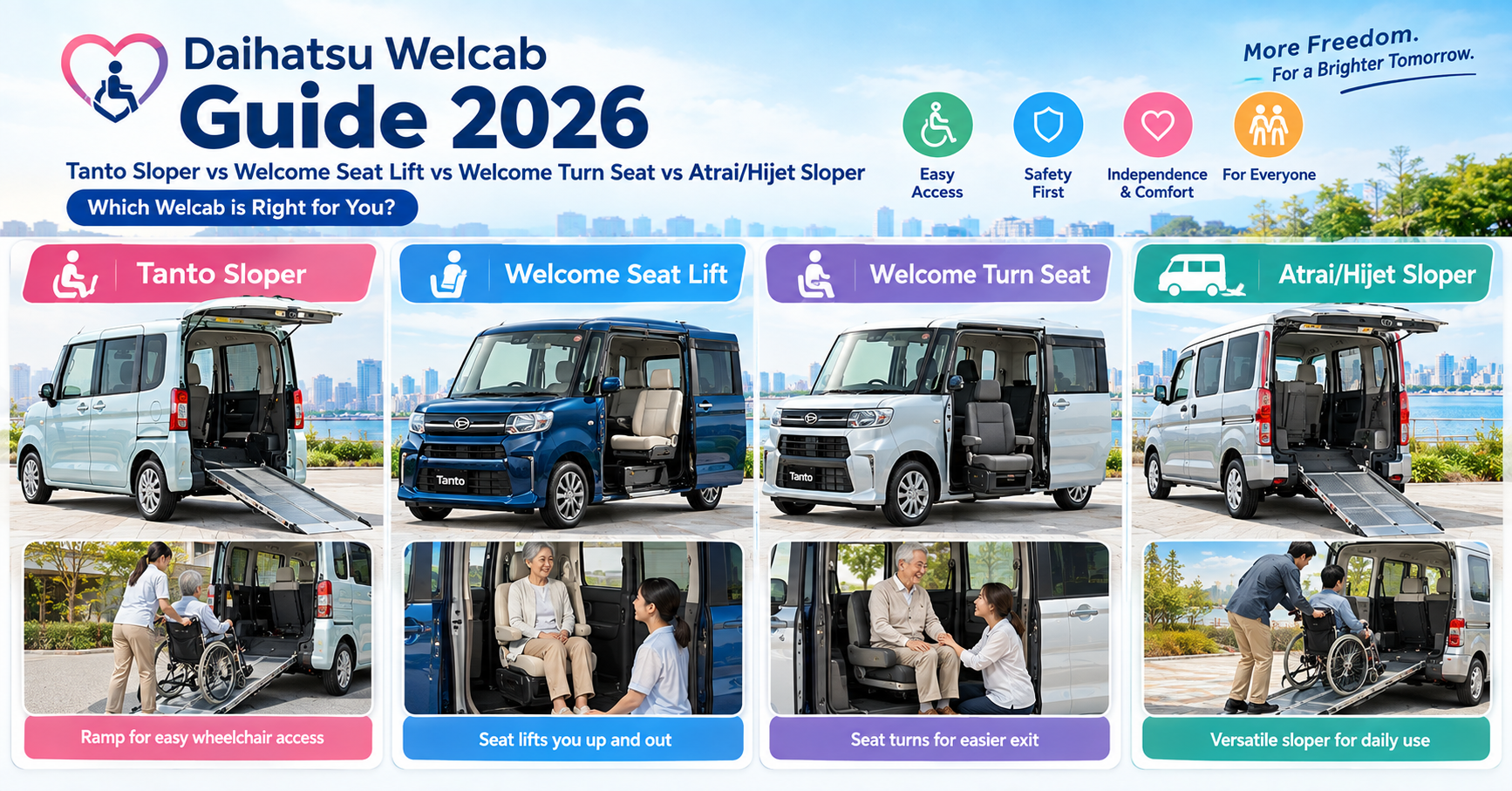
Daihatsu's own guidance for choosing between these vehicles starts not with the car, but with the person's actual mobility situation. There are three fundamentally different mechanisms on offer, each solving a different problem:
- Turn Seat (回転シート車) — the passenger seat itself rotates outward to a boarding-friendly angle, paired with a grip handle. Best for someone who can walk and stand independently if they have something to hold onto, but finds twisting the body during boarding physically difficult — or for anyone who regularly boards in spaces too tight to fully open the door.
- Seat Lift (昇降シート車) — the seat electrically rotates and lowers to a lower height, making the transfer from a wheelchair to the car seat itself easier and safer. Best for someone whose leg and knee strength has declined enough that standing and sitting transfers are difficult, or who wants to travel seated in the car rather than remaining in their wheelchair.
- Sloper (車いす移動車) — a gently sloped ramp at the rear, combined with an electric winch, lets the person ride to their destination while remaining in their own wheelchair. Best for someone for whom transferring out of a wheelchair is difficult or physically taxing for a caregiver, or for households that also need to carry four passengers at other times.
Daihatsu is explicit that the "right" choice depends on the specific person's condition, their wheelchair's size, and how many people are typically helping with boarding — not a fixed rule based on care-need level alone.
All Four Models Are Sold Consumption-Tax-Exempt
Every price in this guide is listed by Daihatsu as non-taxable (消費税非課税) — a genuine, structural price advantage certified welfare vehicles receive under Japanese tax law, not a discount or promotion. Beyond the purchase price itself, Daihatsu also points buyers toward available preferential tax treatment and subsidy programs for welfare vehicles, worth investigating with a dealer or local authority before finalizing a purchase, since eligibility and amounts vary.
Tanto Welcome Turn Seat
The simplest and least expensive of the four, built for buyers who mainly need help with the boarding motion itself rather than a full mobility aid.
| Grade | Price (JPY, tax-exempt) |
|---|---|
| Custom RS (Turbo) | From ¥2,025,000 |
| X | From ¥1,685,000 |
| L | From ¥1,545,000 |
Key features:
- The front passenger seat rotates to an optimal boarding angle, paired with a grip handle for support
- Power crane standard — an electrically assisted lifting mechanism to help load items (such as a folded wheelchair) with minimal physical effort
- Optional dealer-fit "Miracle Auto Step," a fold-out long step making entry and exit easier (requires a simplified side cover or optional side lower skirt when fitted to X or L grades)
- Available in 2WD or 4WD, CVT only
- Daihatsu specifically notes day-to-day usability is unchanged from a standard Tanto, making this a strong fit for buyers who don't want the driving experience to feel meaningfully different from an ordinary car
Tanto Welcome Seat Lift
A step up in mechanical complexity: the seat doesn't just rotate, it powers down to a lower height for a genuinely easier transfer.
| Grade | Price (JPY, tax-exempt) |
|---|---|
| Custom RS (Turbo) | From ¥2,180,000 |
| X | From ¥1,840,000 |
| L | From ¥1,700,000 |
Key features:
- Two lift/lower patterns, selectable depending on the situation
- Electric seat rotation combined with power lowering, reducing the physical effort needed for both the passenger and any caregiver assisting
- The wheelchair itself can be folded and stored inside the vehicle after the passenger transfers to the seat
- Available in 2WD or 4WD, CVT only
- Like Welcome Turn Seat, Daihatsu emphasizes this doesn't compromise day-to-day usability versus a standard Tanto — a genuine consideration for households that will use the car for ordinary errands most of the time and welfare transport some of the time
Tanto Sloper
For situations where transferring out of the wheelchair isn't practical or desired at all — the passenger rides the entire trip in their own wheelchair.
| Grade | Price (JPY, tax-exempt) |
|---|---|
| Custom RS (Turbo) | From ¥2,140,000 |
| X | From ¥1,820,000 |
| X, Turn Seat specification (Sloper + front passenger turn seat combined) | From ¥1,920,000 |
| L | From approximately ¥1,665,000 |
Key features:
- A gently graded rear ramp with an electric winch, letting the wheelchair user board and disembark with minimal physical strain on either the passenger or a caregiver
- Rear seats are removable, so the cabin can flex between wheelchair-accessible configuration and genuine 4-passenger family use
- The "X, Turn Seat specification" variant is a genuinely clever combination: it retains the rear wheelchair ramp and adds a rotating front passenger seat, meaning a household with more than one mobility need — or a family that sometimes needs wheelchair access and sometimes just needs easier front-seat boarding for another passenger — can cover both from a single vehicle
- Available in 2WD (and 4WD on most grades), CVT only
- Daihatsu positions this specifically for buyers who also need genuine 4-person carrying capacity beyond just the wheelchair user, which neither Turn Seat nor Seat Lift versions are built around in the same way
Atrai Sloper / Hijet Sloper — The Larger Option
Built on Daihatsu's cab-over kei van platform (Atrai/Hijet) rather than the Tanto tall-wagon body, these offer meaningfully more interior space for buyers who find Tanto Sloper's cabin too tight.
| Model | Price (JPY, tax-exempt) |
|---|---|
| Atrai Sloper (Turbo) | From ¥2,250,000 |
| Hijet Sloper | From ¥1,810,000 |
Key features:
- Significantly more generous, adaptable cargo/passenger space than Tanto Sloper, thanks to the cab-over van body style
- A forward-folding ramp design that also enables a genuinely flat cargo floor when the ramp isn't in use — useful for households that need to haul bulky items as often as they need wheelchair access
- As of March 2026, Daihatsu states these were the first vehicles in the kei cab-over van class to offer a Smart Inner Mirror (digital rearview mirror, manufacturer option) and, on Atrai Sloper specifically, the first application of an FR-type CVT in this vehicle class — genuine engineering firsts for this specific body style, not just marketing language
- Available in 2WD or 4WD, CVT only
- The natural choice if you've compared Tanto Sloper's dimensions against your wheelchair and caregiving setup and concluded you need more room to maneuver inside the vehicle
Full Comparison Table
| Consideration | Welcome Turn Seat | Welcome Seat Lift | Tanto Sloper | Atrai/Hijet Sloper |
|---|---|---|---|---|
| Best for | Can walk with support, struggles to twist while boarding | Reduced leg/knee strength, needs easier transfer | Wants to remain in wheelchair throughout the trip | Same as Tanto Sloper, but needs more interior space |
| Base body | Tanto (tall wagon) | Tanto (tall wagon) | Tanto (tall wagon) | Atrai/Hijet (cab-over van) |
| Mechanism | Rotating front passenger seat + grip handle | Rotating + power-lowering seat | Rear ramp + electric winch | Rear ramp + electric winch (larger cabin) |
| Standard passenger capacity when not in accessibility mode | Full standard seating | Full standard seating | 4 people (rear seats reinstalled) | 4 people |
| Entry price (tax-exempt) | ¥1,545,000 (L) | ¥1,700,000 (L) | ~¥1,665,000 (L) | ¥1,810,000 (Hijet) |
| Top grade (tax-exempt) | ¥2,025,000 (Custom RS Turbo) | ¥2,180,000 (Custom RS Turbo) | ¥2,140,000 (Custom RS Turbo) | ¥2,250,000 (Atrai Sloper Turbo) |
| Turbo option | ✓ (Custom RS) | ✓ (Custom RS) | ✓ (Custom RS) | ✓ (Atrai Sloper) |
| Combinable with front turn seat | N/A (is the turn seat) | ✗ | ✓ (X, Turn Seat spec) | Not specified |
Prices per Daihatsu's official Japan-market pricing, all consumption-tax-exempt. Add for 4WD where available, and for the front-seat trim/interior differences that come with each grade tier (Custom RS, X, L), which broadly mirror the standard Tanto's own grade equipment differences.
Which One Should You Choose?
🪑 Best for Independent Walkers Who Struggle With Twisting
Choose Tanto Welcome Turn Seat. It's the least expensive option, keeps day-to-day driving feel closest to a standard Tanto, and directly solves the specific problem of a difficult twisting motion during boarding.
🔄 Best for Easier Wheelchair-to-Seat Transfers
Choose Tanto Welcome Seat Lift. The power-lowering seat meaningfully reduces the physical demand of transferring, for passengers who want to travel seated rather than in their wheelchair.
♿ Best for Staying in the Wheelchair Throughout
Choose Tanto Sloper, or its X, Turn Seat combination variant if your household also needs an easier front-passenger boarding solution for someone else.
📦 Best for More Interior Space
Choose Atrai Sloper or Hijet Sloper if you've found Tanto Sloper's cabin too tight for your wheelchair, caregiving routine, or additional cargo needs.
Buying a Daihatsu Welcab Vehicle — What to Check
Welfare vehicles carry a few considerations beyond what applies to a standard kei car:
- Confirm the specific mechanism matches the current user's needs, not just the vehicle category — a Turn Seat car and a Seat Lift car solve genuinely different problems, and the right choice depends on the individual's physical condition, which can also change over time.
- Test every powered mechanism directly (seat rotation/lowering, ramp deployment, electric winch) on any used unit before purchase — these are mechanical systems that see real wear, and a fault here isn't cosmetic, it's a functional failure of the vehicle's core purpose.
- Verify wheelchair compatibility specifically — Daihatsu notes that vehicle suitability can depend on the exact size and shape of the wheelchair being used, so confirm fit with your own equipment rather than assuming any Sloper model will accommodate any wheelchair.
- Confirm whether the vehicle's tax-exempt welfare-vehicle registration status transfers with a used purchase, and understand any requirements to maintain that status, since this affects both the vehicle's tax treatment and, potentially, resale considerations.
- Check for dealer-fit options like the Miracle Auto Step separately, since these are optional accessories that may or may not be fitted to any specific used vehicle, and affect real-world ease of use.
- On Atrai/Hijet Sloper models with the Smart Inner Mirror option, confirm functionality directly, since Daihatsu's own notes indicate the backup camera display behavior differs depending on which display audio and vision-assist options are also fitted.
Always confirm the exact model, grade, drivetrain, and full mechanical function history against the chassis number before purchasing, since these vehicles combine standard automotive wear with specialized mobility equipment that needs its own condition check. If you're evaluating a Daihatsu Welcab vehicle from Japan, running the chassis number through a Japanese auction sheet and history check before you commit is the safest way to confirm the vehicle in front of you matches what it's listed as — that's exactly the kind of check we built JPChecker to make simple.
Frequently Asked Questions
What is the difference between Tanto Welcome Turn Seat and Tanto Welcome Seat Lift? Welcome Turn Seat only rotates the front passenger seat to a more accessible boarding angle, paired with a grip handle — suited to someone who can still stand and walk with support. Welcome Seat Lift adds power-lowering to the seat rotation, making it easier to transfer directly from a wheelchair into the car seat.
What is a "Sloper" vehicle? A Sloper is a wheelchair-accessible vehicle with a gently graded rear ramp and an electric winch, allowing the passenger to board and travel while remaining seated in their own wheelchair, rather than transferring to a car seat.
What is the cheapest Daihatsu Welcab vehicle? The Tanto Welcome Turn Seat in L grade, priced from ¥1,545,000 (consumption-tax-exempt).
Why are these vehicles sold without consumption tax? Certified welfare vehicles in Japan receive a structural consumption-tax exemption under Japanese tax law, reflected directly in Daihatsu's listed prices for the entire Welcab lineup covered in this guide.
What is the difference between Tanto Sloper and Atrai/Hijet Sloper? They use the same core ramp-and-winch mechanism, but Atrai/Hijet Sloper is built on a larger cab-over van body, offering meaningfully more interior space for wheelchair maneuvering and cargo, versus Tanto Sloper's more compact tall-wagon body.
Can a Tanto Sloper also have a rotating front passenger seat? Yes — the "X, Turn Seat specification" combines the rear wheelchair ramp with a rotating front passenger seat, useful for households needing both types of accessibility.
Does a Daihatsu Welcab vehicle still seat 4 people normally? Yes, on Sloper models — the rear seats are removable, so the cabin can switch between wheelchair-accessible configuration and standard 4-passenger use. Turn Seat and Seat Lift models retain full standard seating since their accessibility feature is built into the existing seat itself.